
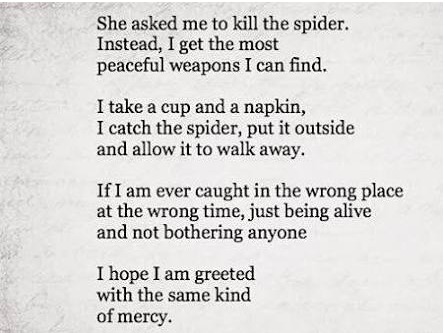
Coincidently in our home, this method is used for every wild trespasser. Be it a spider, house shrew, bug, rat, bat, squirrel, gecko, slug, bird, frog, or for that matter snake. The size of the “cup” changes with the size of the trespasser. Killing a wild creature that enters our home is a strict no-no. That rule is also applicable to our pet cats. They do break the rule now and then following their instinct to hunt. But we make it a point to rescue a relatively unharmed prey and release it back to the garden. The cats of course are extremely disappointed.
I have had the good fortune of being surrounded by plants since childhood. I remember during my college days; I would take a small diversion on my way home to visit a sapling nursery occasionally. This alone time allowed me to soak in the green energy generated by the tiny saplings, a rare treat in the concrete forest of Mumbai. I would carry home a sapling or two to be cared for. This habit continued into my youth until finally my husband, and I decided to build our own home surrounded by a garden. We had a lovely, landscaped garden with a patch of lawn and exotic flowering bushes in the initial years. Our landscape artist had left some empty spaces to plant trees and bushes of our choice.
I remember the very first sapling that we bought was that of ‘Anant’, a small-sized tree with fragrant flowers. Of course, the sapling came with a lot of care instructions so that it grows well and bears a lot of flowers. We followed the instructions to the letter and within a few weeks, the sapling showed the first buds of the long-awaited flowers. One morning to my horror, I found that the buds were chewed off. On closer observation, I saw large caterpillars chomping away at the tender buds. I banished the caterpillars to a nearby bush telling them sternly “Go feed someplace else and leave my ‘Anant’ tree alone”
That same year we got hold of a book authored by Shrikant Ingalhalikar. In one of the chapters, the author narrated his experience with his favorite ‘Bahava’ sapling. He was horrified to see the sapling plagued by caterpillars. He tried all measures of stomping and killing the caterpillars, spraying pesticide, etc to get rid of the bugs, but to no avail. Finally, he observed that the caterpillars had hatched from the eggs of the Common Emigrant butterfly. This discovery sparked a new interest, and he stopped the massacre of the caterpillars. He instead decided to watch the caterpillars develop into butterflies. He noticed that as he allowed the butterflies to thrive, his garden got a lot of other visitors which were not seen before. Spiders and other small insects came to feed on butterfly eggs, small birds came in to feed on the spiders, larger birds came to feed on smaller birds, and so on. Some of these visitors became permanent residents in his garden. Thus, making his garden a livelier place. We were enthralled reading this experience. For us novice gardeners there were quite a few takeaways.
We learned to identify a diseased plant from a healthy plant. If you see the young of any creature merrily chomping away at the tender leaves or buds, there is no need to worry. The plant is very healthy and that is exactly why the mother has chosen to lay eggs on that plant. She wouldn’t have done so if the plant was sick. So don’t bother to bring out the so-called medicines and try to cure the plant.
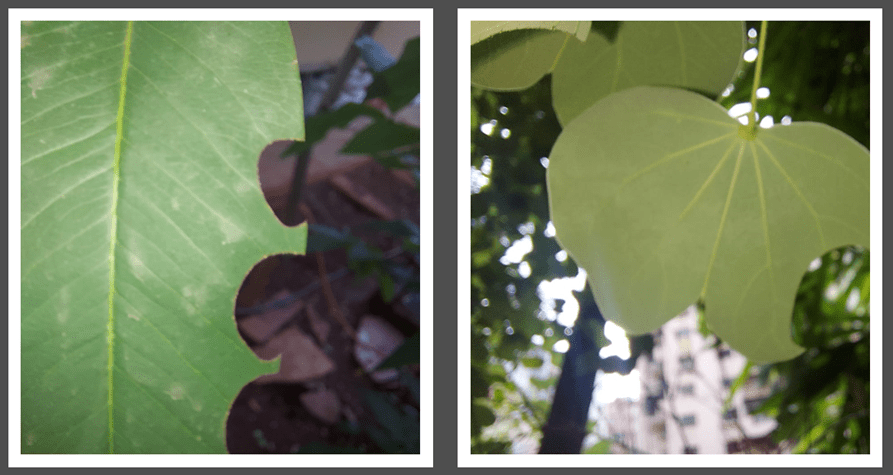
If you are wondering why the insect has chosen your favorite plant, do a little bit of investigation. It may turn out that your favorite plant is the host plant for a specific species. A long time after we started our garden, we came to know that our favorite ‘Kadhipatta’ tree is host to the Common Mormon butterfly. We simply cannot divert Mumma Mormon to lay her eggs someplace else. Kadhipatta and Lime trees are her evolutionary choices for laying eggs. This also means Mumma Mormon has been doing this even before the homo sapiens arrived on the evolutionary horizon.
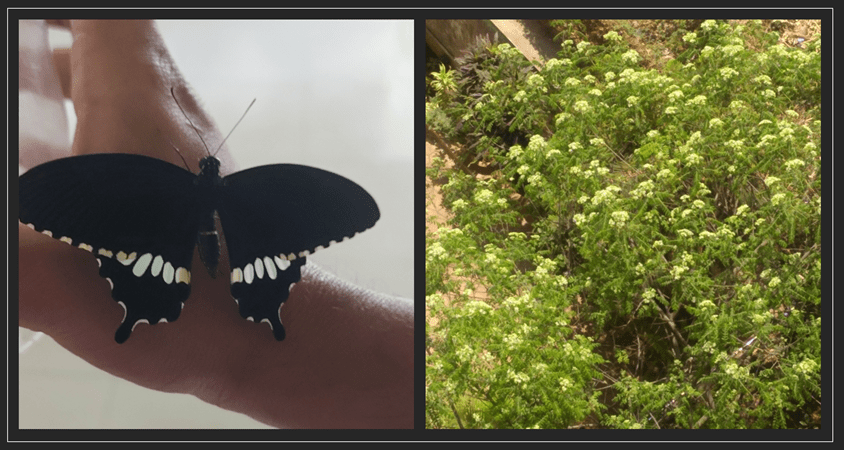
Having insects visit the plant is beneficial to the plants. They facilitate pollination. Thereby aiding fruiting and flowering. Spraying the plants with chemicals to achieve the same result is somehow hard to understand and a bit expensive
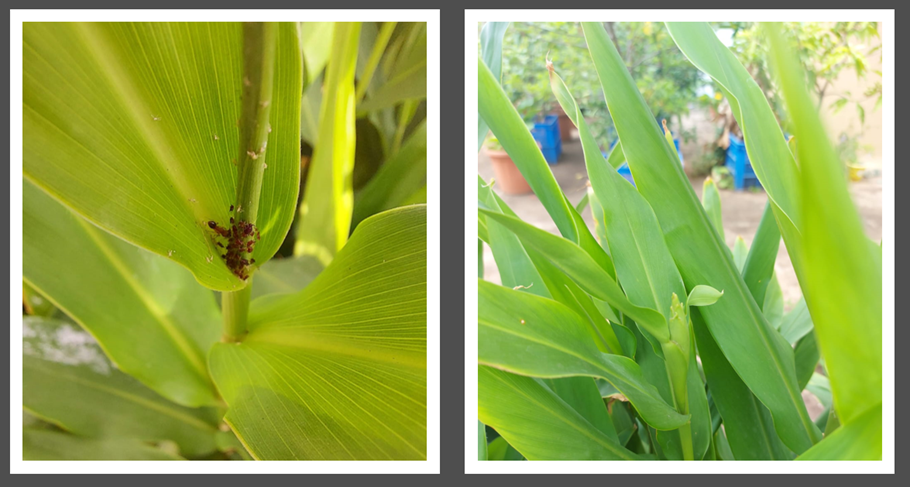
Many times, insects herald that something wonderful is about to happen. This monsoon I was eagerly awaiting my ‘Sontakka’ to bear flowers. One fine morning I saw a clump of ants on a random stalk. The ants were not seen anywhere on other ‘Sontakka’ stalks. I observed that stalk for days. Within a week I got the first glimpse of ‘Sontakka’ bud. I have been showered with lovely fragrant flowers ever since.
What is Wildlife and why should it matter at all? Wildlife is creatures who are not humans and are not domesticated. So even an insignificant ant, sparrow, spider, grasshopper, or lizard is wildlife. There is no need to take a trip to the wildlife sanctuary to meet and greet the wild. Those wild creatures can be in any place. That any place could be right outside our doorstep.
Since ancient times human ancestors have observed the wildlife at their doorsteps to make near accurate weather predictions, or predictions relating to natural calamities. With the advent of the modern age, we homo sapiens have elevated ourselves above the rest of the animal and plant world. These wild creatures are more than just bugs or pests. For once, they have existed for millions of years before we came along. They do not speak our language, but they do communicate.
For instance, the velvet mite is gone all summer. But it appears out of nowhere when it is going to rain, and rain it does when the velvet mite is sighted! The termites know the exact moment to leave their nest. Just before it starts raining, that too the first rain of the season, millions of young queen termites and drones leave their home in search of the mate. How can they accurately predict rains? Honeybees can keep a count of days ever since they hatch out of their eggs. They promote themselves in the hive hierarchy as they age day by day taking over tasks of increasing responsibility. How did they learn math? Frogs can find the shortest route to the water. Where did they get the map of the area? There are numerous such examples to learn from.
And yet, we humans fail to show them mercy let alone welcome them in our lives. Going back to the quote by Rudy Francisco, can we not think of this wildlife as some creature caught in an unwanted situation and let them pass or pick them up and gently place them out of our way? Can we not give them a second chance? What if tomorrow we found ourselves in the wrong place and time, will we not expect to be treated with mercy?
Our beautiful, landscaped garden, the patch of lawn, and the exotic bushes are long gone. But we don’t regret the loss. They are now replaced by freely growing shrubs and trees that although selected and planted by us are never pruned. They provide the much-needed space and hideout for all the wildlife in our surroundings. The creatures now probably know that our neighbors may not be tolerant of them, but they are always welcome in our garden.
Environmentalists and scientists all around the world say that if humans are wiped out, wildlife will thrive. However, if the wildlife is wiped out, humans don’t stand a chance to survive. This is how important wildlife is. But all hope is not lost. We can do our tiny bit and dedicate some space in our homes and neighborhoods to wildlife. Have some dedicated corners which imitate wild spaces forming tiny sanctuaries within the urban spaces. And yes, if at all a wild creature mistakenly crosses your path, please do have a cup and napkin ready!
Shivangi Chandrashekhar Datar
13-Aug-2022


Wow!! Thanks for writing this Shivangi.
A very important point of view, which most of the people ( whoz minds are away from nature) miss and use hundreds of chemicals to ‘clean’ things be it the floor, toilets, walls etc… Unfortunately we don’t understand that all the chemicals we use to ‘clean’; are coming back to us… thru air, water and food.
Anyway… thank you once again..
LikeLiked by 1 person
You look deep into nature, and so you understand everything better
LikeLiked by 1 person